
Why Your Furnace is Short-Cycling and How to Fix It
See why your furnace keeps shutting off this fall. We offer local service expertise and area tips to help you decide when to call a Fenton heating pro.
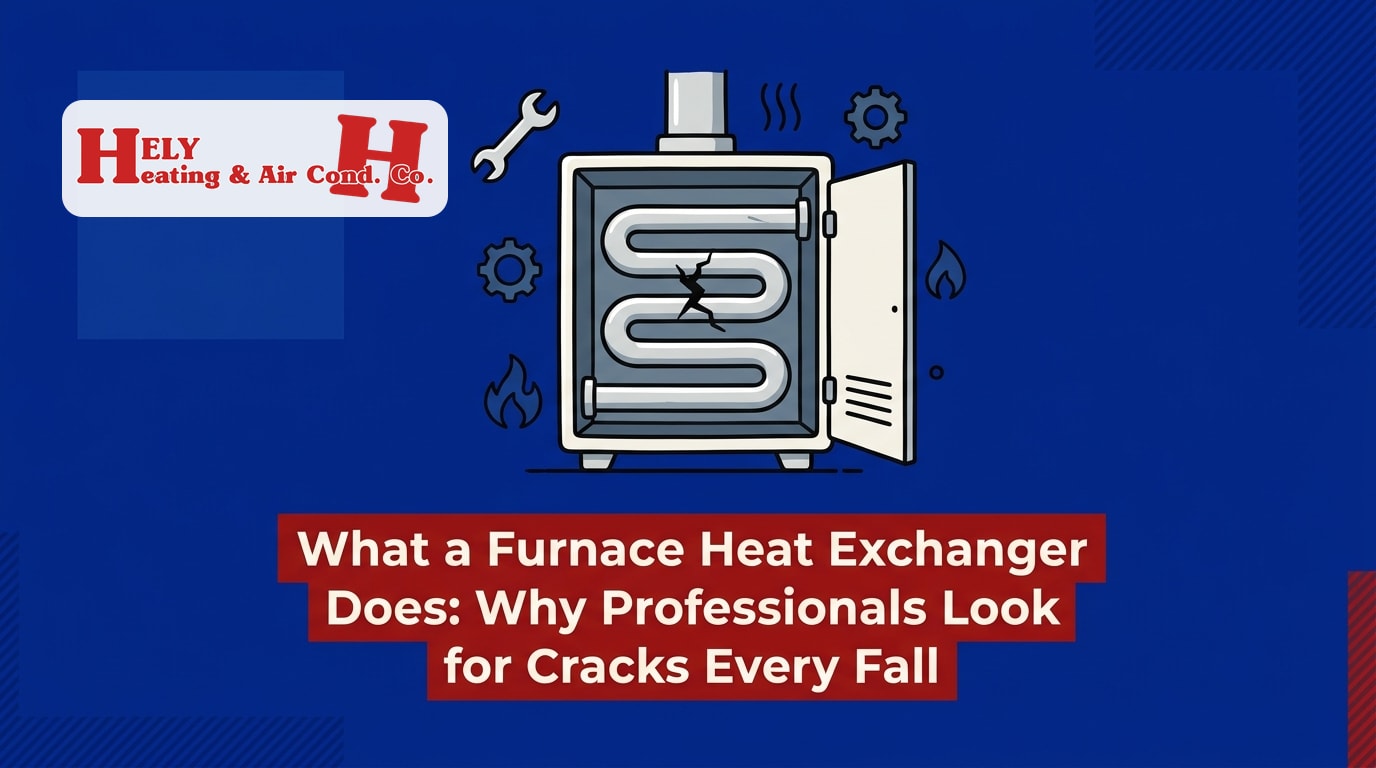
Your furnace fires up, the blower fan kicks on, and warm air fills your living room. It feels like a simple, straightforward process. However, behind that metal cabinet is a complex and highly controlled sequence of combustion. If you are wondering exactly what a furnace heat exchanger does, our team at Hely Heating and Air Conditioning Co. believes you are asking the most important question about your home's winter safety. This single component is the most critical, yet least visible, part of your entire heating system.
Here is the thing: generating heat requires burning fuel, which creates toxic exhaust gases. The heat exchanger is the vital metal shield standing between that dangerous exhaust and the air your family breathes. When this shield is brand new, it does its job flawlessly. But as a furnace ages, the constant stress of heating up and cooling down takes a heavy toll. Over time, this wear and tear can create invisible micro-cracks in the metal.
These microscopic fractures represent a severe concrete problem for homeowners. Even a hairline crack can leak dangerous carbon monoxide into your home during the heavy winter heating season. Because this component is buried deep inside the furnace cabinet, you will never see these cracks simply by changing your filter or looking at the unit.
This creates a critical decision point for proactive homeowners. Recognizing the necessity of a professional fall inspection to verify your heat exchanger's structural integrity is the only way to ensure your system is safe to operate. Prioritizing your November pre-winter readiness checklist is the best defense against these hidden hazards as you prepare your home for the holiday season. By investing in professional heating services, you ensure that a trained technician thoroughly evaluates this vital barrier before the freezing temperatures arrive.
To fully grasp why this component is so crucial, it helps to understand how it operates as the ultimate safety barrier. In simple terms, a furnace heat exchanger acts as a metal shield that transfers heat from the combustion chamber to the air circulating through your house. Without this barrier intact, the combustion process would be fundamentally unsafe for indoor environments.
When your thermostat calls for heat, the furnace ignites gas or oil inside a sealed combustion chamber. The flames heat up the metal walls of the heat exchanger. As the metal gets extremely hot, your furnace's blower motor pushes cold indoor air across the outside of these hot metal walls. The air absorbs the heat and travels through your ductwork to warm your rooms. At no point does the breathable air actually touch the flames or the exhaust fumes.
In our years keeping Fenton MO area homes warm, we have seen firsthand that the reliable operation of this barrier is absolutely critical. The demands of freezing winter temperatures mean your furnace will run for hours at a time, making the integrity of this metal shield a matter of life and safety.
The entire design of a modern furnace revolves around keeping two distinct airflows completely separated. If these two paths ever cross, the system has failed.
1. The Combustion Path: Fuel burns inside the heat exchanger. The resulting toxic gases (including carbon monoxide) travel safely through the inside of the metal tubes or clamshells and are vented directly outside your home through a dedicated flue pipe.
2. The Breathable Air Path: The blower motor pulls cold air from your home's return vents, pushes it over the hot exterior surface of the heat exchanger to warm it up, and sends it back into your living spaces.
3. The Strict Separation: The metal walls of the heat exchanger are the only thing keeping the toxic exhaust inside the tubes from mixing with the clean air blowing over the outside of the tubes.
If a crack develops in that metal wall, the separation is broken. The high pressure from the blower motor can disrupt the drafting of the exhaust, pushing toxic gases out of the crack and into the breathable air path.
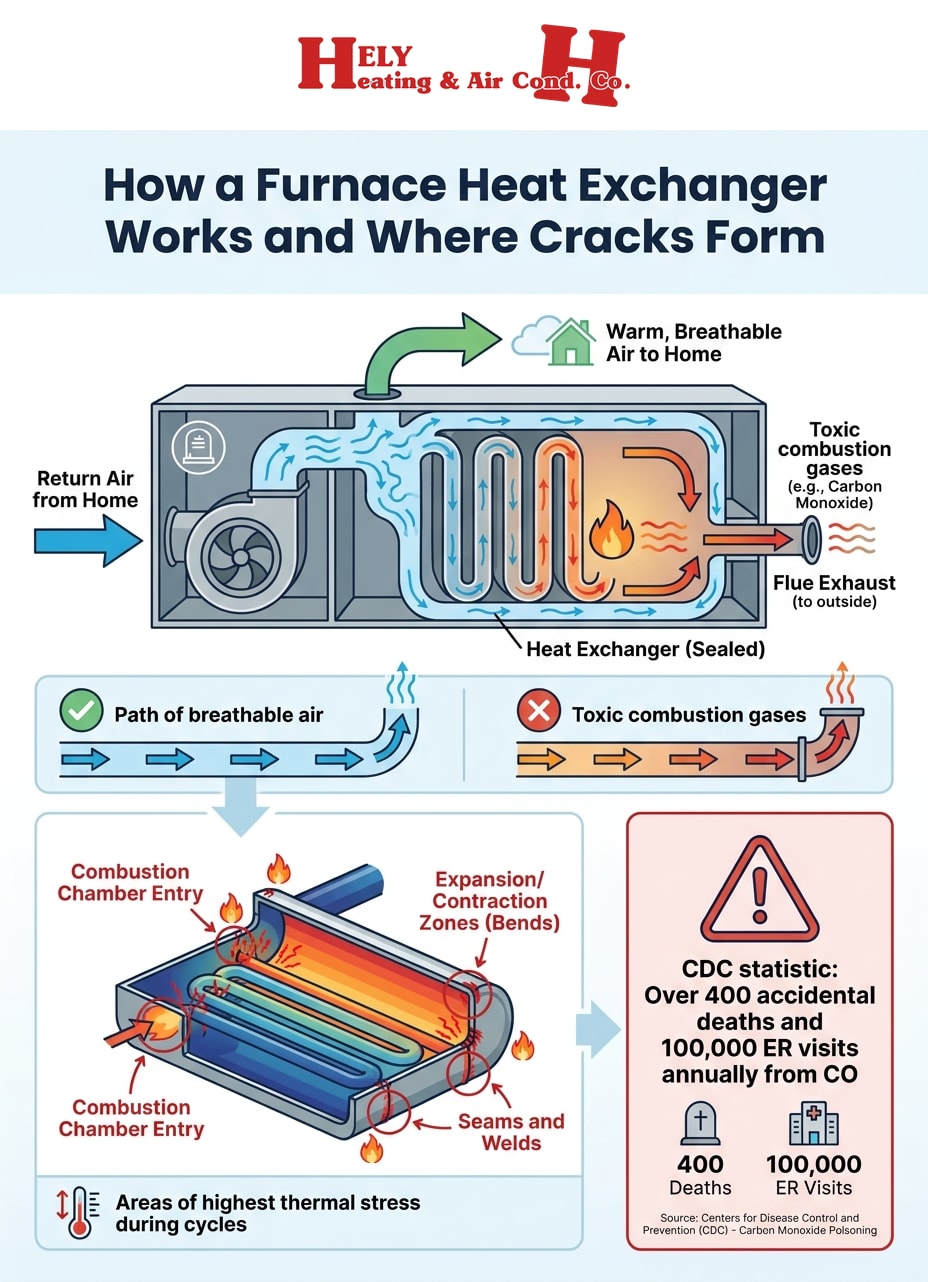
You might wonder why a thick piece of metal would ever crack in the first place. The short answer is thermal stress. Every time your furnace turns on, the heat exchanger undergoes extreme temperature fluctuations. Within minutes, the metal goes from a cold, resting state to several hundred degrees.
The Problem: When metal heats up, it naturally expands. When the heating cycle finishes and the burners shut off, the metal cools down and contracts. This expansion and contraction happens every single time your furnace runs. During a cold winter, a furnace might cycle on and off dozens of times a day.
The Cause: The heavy, constant furnace cycling required during cold local winters multiplies the expansion and contraction stress on the metal. Over years of operation, this continuous movement alters the microscopic grain structure of the metal. Just like bending a paperclip back and forth repeatedly will eventually cause it to snap, years of thermal stress inevitably lead to metal fatigue. The metal becomes brittle, and microscopic fractures begin to form in the weakest areas, typically near the curves or welds.
The Solution: Because metal fatigue is an unavoidable mechanical reality of aging heating equipment, our technicians consider seasonal checks non-negotiable. November pre-winter readiness inspections are specifically timed to catch these stress fractures before the heavy daily cycling of winter begins.
• New System (1-5 Years) — Impact of Thermal Stress: Metal is highly resilient. Expansion and contraction happen smoothly with minimal fatigue. — Inspection Priority: Baseline checks to ensure proper airflow and prevent premature overheating.
• Mid-Life (6-12 Years) — Impact of Thermal Stress: Metal fatigue begins to set in. The constant cycling starts to weaken stress points near bends and welds. — Inspection Priority: Detailed visual inspections and combustion analysis to monitor wear and tear.
• Aging System (13+ Years) — Impact of Thermal Stress: Metal is brittle. The risk of hairline fractures opening during the heating cycle is significantly elevated. — Inspection Priority: Rigorous, advanced testing using cameras and digital analyzers to detect active leaks.
When a heat exchanger fails, it is not just a mechanical breakdown that leaves you shivering in the cold. It is a severe safety emergency. The primary byproduct of burning natural gas, propane, or heating oil is carbon monoxide (CO).
Carbon monoxide is an incredibly dangerous gas because it is entirely invisible, odorless, and tasteless. You cannot see it filling a room, and you cannot smell it in the air. According to data from the Centers for Disease Control and Prevention (CDC), carbon monoxide is responsible for over 400 accidental deaths and 100,000 emergency room visits annually in the United States.
Even a microscopic crack in the heat exchanger allows this toxic gas to escape the combustion chamber. Because the furnace blower fan is actively pushing air over the cracked metal, the carbon monoxide gets picked up and distributed through the ductwork into every room of your house. What makes this hazard even more insidious is that the symptoms of low-level carbon monoxide exposure—headaches, dizziness, nausea, and fatigue—are often mistaken for a common winter cold or the flu.
This hidden hazard severely compromises your overall indoor air quality. For Fenton MO area homes, where doors and windows are sealed tight against the winter chill, a gas leak has nowhere to escape. While installing carbon monoxide detectors is a critical baseline defense, exploring comprehensive indoor air quality solutions can provide secondary layers of monitoring and ventilation to keep your indoor environment healthy.
Most homeowners don't realize that inspecting a heat exchanger is incredibly difficult. You cannot simply take off the front panel of the furnace, shine a flashlight inside, and declare the system safe. Hairline fractures are notoriously elusive.
When the furnace is turned off and the metal is cool, these micro-cracks often close up tight, making them completely invisible to the naked eye. It is only when the burners ignite and the metal heats up and expands that the cracks open wide enough to leak toxic gases. This is why a simple visual check by a homeowner is entirely insufficient for detecting these hidden hazards.
Our team at Hely Heating and Air Conditioning Co. relies on highly specialized tools and formal training to diagnose this component accurately. Technicians use advanced digital combustion analyzers to test the exhaust flue gases. By reading the exact parts-per-million of oxygen and carbon monoxide in the exhaust, an analyzer can detect abnormal pressure changes that indicate a crack, even before a camera sees it. If the analyzer flags an issue, technicians use high-definition, flexible inspection cameras to snake deep into the heat exchanger cells and visually confirm the fracture.
This level of diagnostic work is never a DIY task. It requires a commitment to rigorous, safety-first inspections by trained professionals who prioritize protecting local families. When you schedule your November pre-winter readiness check, you are paying for this specialized expertise. Following essential furnace tune-up tips always starts with bringing in a qualified professional who knows exactly where these stress fractures hide.
If a professional technician discovers a crack in your heat exchanger, the furnace will be immediately shut down and tagged for safety reasons. The next question homeowners ask is usually, "Can it be fixed?"
The short answer is no. A cracked heat exchanger cannot be safely patched, welded, or repaired. The extreme thermal stress of the heating cycle would immediately break any weld or high-temperature sealant. The only safe resolution is replacement. However, you have two distinct paths forward: replacing just the heat exchanger component, or replacing the entire furnace.
A pattern we see often in our service area is that the age of your furnace usually dictates which path is the wiser investment. If your furnace is relatively new and the heat exchanger failed prematurely, the component is often covered under the manufacturer's warranty, making a part replacement the logical choice. But if your furnace is over 10 to 12 years old, putting a brand new heat exchanger into an aging system is rarely recommended. The labor to tear down a furnace and rebuild it with a new heat exchanger is extensive, and other aging components like the blower motor or control board are likely nearing the end of their lifespans as well.
For older Fenton MO area homes facing a failed inspection, we frequently recommend a full system replacement because it opens the door to modern, highly efficient alternatives. Many homeowners choose to transition to heat pump systems, which provide both heating and cooling without burning fossil fuels indoors, completely eliminating the risk of carbon monoxide leaks. Additionally, general energy rebates or federal tax credits may apply to qualifying high-efficiency upgrades, helping to offset the initial investment. We always advise readers to verify current programs with their utility provider or a tax professional to see what incentives are available in their area.
Continuous thermal expansion and contraction over years of use leads to metal fatigue and eventual cracking. Every time the furnace heats up, the metal expands, and when it cools, it contracts. After thousands of cycles, the metal becomes brittle and develops stress fractures, usually near curves or welded seams.
No, you should never run a furnace with a cracked heat exchanger. Operating the system in this condition poses an immediate and severe carbon monoxide risk to your household. The crack allows toxic combustion gases to escape the sealed exhaust path and mix directly with the warm air blowing into your living spaces.
Technicians use specialized diagnostic equipment to detect cracks that are invisible to the naked eye. They use digital combustion analyzers to detect abnormal gas levels and draft pressures, which indicate a breach in the metal. If an abnormality is found, they use high-definition, flexible inspection cameras to navigate deep into the furnace cells and visually confirm the fractures.
While carbon monoxide may not leak continuously, the risk is always present and highly unpredictable. The danger peaks when the metal expands during the heating cycle, which can cause a dormant hairline crack to open up. Furthermore, the high pressure from the blower fan can alter the pressure dynamics inside the cabinet, actively pulling toxic gases out of the crack and into your home's air supply.
A typical furnace heat exchanger is designed to last between 15 and 20 years, provided the system receives proper airflow and regular maintenance. Neglecting seasonal tune-ups, running the system with a clogged air filter, or having an oversized furnace can cause the system to overheat frequently, drastically accelerating metal fatigue and shortening the lifespan of the component.
Understanding exactly what a furnace heat exchanger does highlights exactly why professional oversight is so crucial. This component is not just a metal box that makes your house warm; it is the primary safety shield standing between your family and dangerous combustion gases. Catching micro-cracks early ensures a safe, warm, and worry-free winter season.
Before the freezing temperatures settle in and your furnace begins running around the clock, take action to secure your home. Prioritizing your November pre-winter readiness means getting ahead of mechanical failures before they become safety emergencies. We encourage you to proactively schedule your seasonal check-up through a comprehensive preventative maintenance plan. Having a licensed professional verify the structural integrity of your system provides the ultimate peace of mind when you need your heating system the most.

Building trust, one satisfied customer at a time. Read their stories.

Great experience! Would definitely recommend and will be using/referring in the future.

Wonderful service was here on short notice to help on a really hot day. I will be recommending and using for other properties.
Tim was efficient and knowledgeable. He explained everything he did and what the problems were. I would recommend them.
We have been using Hely for years. Professional, prompt and courteous service.
never have a need to call anyone else, they are the best, also refer a lot of people to them because they know how to treat people and get the job done with top quality service techs and office staff
Very helpful on installing my new thermostat. Assisted in set up too. We’ve used Hely for a very long time and will continue to do so. Have also had new furnace and A/C installed by Hely. Great staff
Amazing Service! They are great! Our AC went out after the 4th of July, and Tim came out that same day to repair our unit. He diagnosed the issue in less than 10 minutes, and had it fixed in less than 5. I am extremely grateful for their great service and quick resolution! I would highly recommend calling them!
Family has been using Hely for years. Always on time, polite, professional. Very responsive and they have an emergency line for when the weather is bad and you need help. Installed a new furnace and A/C for our new house within the last year and we're very happy.
They explained everything in terms that I could understand. The installers were very courteous & did a great job cleaning up. I highly recommend giving them a call.
They always come when called to service our heating & cooling system. Good prices, always fair and friendly service.
Never have a need to call anyone else, they are the best, also refer a lot of people to them because they know how to treat people and get the job done with top quality service techs and office staff
Korky has been working with our family for a long time. He is always so nice and efficient that we usually always hope to get him when we call you guys. He really cares for his customers and is always so professional. I’m really glad you have someone like korky on your team.