.avif)
Deciding Whether to Repair a Limping AC in September or Wait Until Spring Replacement
When your cooling system starts struggling at the end of summer, the repair-versus-replace math changes. Evaluate your failing unit before heating season begins.

Are you staring at your thermostat, wondering why your vents suddenly smell like a campfire? Here at Hely Heating & Air Conditioning Co., we field dozens of calls every October from Fenton homeowners experiencing this exact panic. Mastering home maintenance tips and troubleshooting starts with knowing exactly how to handle your mid-fall heating startup. You rely heavily on your cooling equipment throughout the long summer months, but the sudden shift to heating in the autumn often brings unexpected odors and strange sounds that can cause immediate anxiety. The central decision you face is identifying whether that unsettling symptom is just harmless dust burning off the internal components, or a severe mechanical hazard threatening your property.
While basic visual observation and filter checks are always encouraged, invasive troubleshooting of combustion appliances is strictly reserved for licensed professionals. In our experience, understanding how your air conditioning systems interface with your heating equipment can help you make a safe, informed decision before the freezing weather arrives.
To understand why your furnace smells terrible in the fall, you have to look at what happened over the summer. Our technicians know firsthand that Fenton MO experiences an intensely hot and humid continental climate, which accelerates dust caking and potential surface corrosion on dormant furnace parts between May and October. Even if your cooling system ran perfectly all season, the heating components were sitting in a dark, damp environment.
The science behind this seasonal dust burn-off phenomenon follows a predictable pattern that our team sees in homes across the area:
1. Moisture accumulation: High summer humidity levels cause condensation to form on and around the dormant metal surfaces of your furnace, particularly the heat exchanger.
2. Debris adhesion: As indoor air circulates through the ductwork during the cooling season, airborne dust, pet dander, and microscopic debris stick to this lingering moisture, eventually drying into a caked-on layer.
3. Thermal reaction: When the furnace ignites for the first time in October, the internal temperatures rapidly spike. This bakes the accumulated debris, releasing soot and strong odors directly into your airflow.
It is important to note that even homes that recently had a professional AC installation can experience this intense, temporary burning odor if the internal heating components were not thoroughly cleaned during the off-season.
Knowing the difference between a minor nuisance and a major emergency is the foundation of safe homeownership. During your October mid-fall heating startup, your primary diagnostic tool is your sense of smell. You must apply clear, non-DIY criteria to evaluate the type and duration of the odors coming from your registers.
• The normal dust burn-off smell: This scent closely resembles a dusty, heated radiator or a warm hair dryer. It should be relatively mild and, most importantly, it has a strict timeline. The odor should completely dissipate within one to two hours of continuous operation.
• The burning plastic smell: If you detect an odor similar to melting plastic or burning rubber, this indicates a severe electrical hazard. It usually means wire casings are melting or a foreign object has fallen into the heating cabinet.
• The electrical ozone smell: A sharp, metallic scent (often described as smelling like a lightning storm) points to an overheating blower motor or a failing electrical component.
• The rotten egg smell: This is an absolute emergency. Natural gas is odorless, but utility companies add a chemical called mercaptan to give it a distinct sulfur or rotten egg scent.
If you detect any of the dangerous odor profiles, take immediate safety steps. Shut off the unit at the thermostat. If you smell gas, evacuate the premises immediately and contact your utility provider. We always remind our customers: under no circumstances should you attempt DIY teardowns or remove the furnace access panels to investigate electrical or gas-related smells. Observation is the only safe form of homeowner troubleshooting for these symptoms.
Smells are not the only warning signs during the fall transition. When our crews perform fall maintenance calls in Fenton MO, we frequently encounter strange mechanical noises and erratic operational patterns when firing up dormant equipment. One of the most common issues we diagnose is short-cycling, a condition where the furnace turns on, runs for a minute or two, and then shuts off rapidly before the house reaches the target temperature.
Short-cycling can be caused by something as simple as restricted airflow, or it can indicate severe internal overheating that triggers the system's high-limit safety switch. Before assuming the worst, you should check basic items like your thermostat settings and your air filters. As we often tell our clients, a completely clogged filter starves the system of air, forcing it to shut down to prevent a fire.
You also need to differentiate between normal seasonal sounds and dangerous mechanical failures:
• Normal ductwork popping: As hot air rushes through cold metal ducts, the sudden temperature change causes the metal to expand. This creates mild popping or ticking sounds that are completely harmless.
• Dangerous scraping noises: A harsh metal-on-metal grinding sound usually indicates that the blower motor bearings are failing or the blower wheel has broken loose from its housing.
• Loud banging upon ignition: If you hear a loud "boom" or bang right as the heating cycle starts, this is called delayed ignition. Gas is building up inside the combustion chamber before the igniter lights it, creating a miniature explosion. This requires immediate professional repair.
Establish a hard boundary for yourself: if changing the air filter and ensuring the vents are open does not stop the short-cycling or the strange noises, a licensed professional must intervene. Continuing to run a malfunctioning system will only cause catastrophic damage.
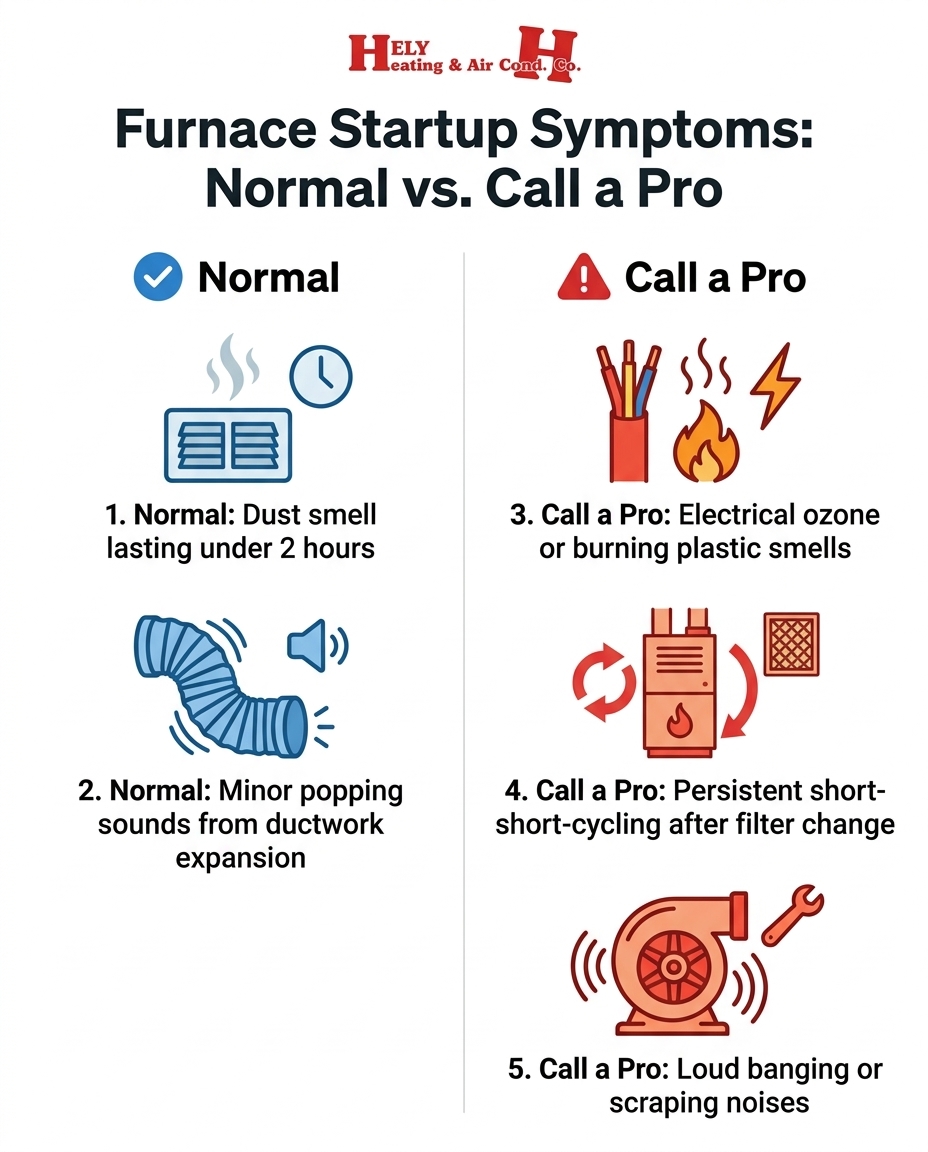
To help you navigate your October mid-fall heating startup safely, use this definitive comparison separating normal seasonal symptoms from dangerous hazards that require a licensed expert.
• Odors — Normal Seasonal Behavior (Monitor): Mild dusty smell lasting under 2 hours — Dangerous Hazard (Call a Pro): Burning plastic, electrical ozone, or rotten eggs
• Noises — Normal Seasonal Behavior (Monitor): Mild popping or ticking from expanding ducts — Dangerous Hazard (Call a Pro): Loud banging, scraping, or heavy rattling
• Operation — Normal Seasonal Behavior (Monitor): Running continuous cycles until target temp is reached — Dangerous Hazard (Call a Pro): Short-cycling repeatedly after a fresh filter change
• Airflow — Normal Seasonal Behavior (Monitor): Consistent, warm air from all unblocked registers — Dangerous Hazard (Call a Pro): Weak, lukewarm airflow or no air pushing through
The Environmental Protection Agency (EPA) explicitly recommends annual pre-season inspections for combustion heating systems to prevent carbon monoxide hazards. Misdiagnosing a cracked heat exchanger or an electrical fault can lead to severe safety risks for your household. Our local experts at Hely Heating & Air Conditioning Co. are equipped with specialized combustion analyzers and diagnostic tools to safely uncover what a homeowner simply cannot see.
If your observation reveals a major failure—such as a cracked heat exchanger or a seized blower motor—you are suddenly faced with a critical decision: do you invest in an expensive repair, or is it time for a full replacement? In Fenton MO, we find this decision often hinges on the age of your equipment and the long-term financial logic of addressing both your heating and cooling units simultaneously.
When a furnace fails, addressing an aging cooling system at the same time is often the most mechanically sound choice. The indoor evaporator coil for your air conditioner sits directly above the furnace; replacing them together ensures perfect airflow matching and saves significantly on overlapping labor costs. An honest technician will always advise against premature replacement if a simple repair is viable, but we will also guide you on the most cost-effective long-term solution so you aren't paying for two separate installations a year apart.
Recently, our team helped a local customer who needed a new A/C and furnace installation during the summer. They noted that our technicians explained everything clearly, completed the entire project in a single day, and left the workspace spotless—a level of efficiency that made the replacement process stress-free. If you are weighing an AC replacement alongside a furnace upgrade, remember that generic energy rebates or federal tax credits may apply to qualifying high-efficiency systems, making fall an ideal time to upgrade your home's infrastructure.
The quality of the installation matters just as much as the brand of the equipment being installed. Hely Heating & Air Conditioning Co. is committed to precise installation standards and deep local expertise, ensuring long-term system reliability for your home. Even the most advanced, high-efficiency furnace will fail prematurely if the ductwork is not sealed or if the cooling coil restricts the heating airflow.
Improper sizing or rushed installation of cooling components can severely impact your heating performance. If the blower motor has to fight against a poorly fitted coil, it draws excess electricity and wears out faster. A full system upgrade can often be completed efficiently in a single day by an organized, professional team, minimizing the disruption to your October mid-fall heating startup routine. For instance, our installation crew recently outfitted a new construction home with a complete furnace and cooling system, and the homeowner was incredibly happy with our meticulous, clean, and patient process.
Whether you need a massive residential overhaul or a standard AC installation in Kirkwood, choosing a local contractor who prioritizes clean work environments and exact sizing calculations is non-negotiable.
Cutting corners during the installation process leads directly to premature wear and tear. In our years of repairing botched jobs, we've seen how improperly brazed refrigerant lines or unleveled furnaces cause internal components to suffer from excess vibration and strain. There is a direct correlation between precise installation and manageable utility costs. Understanding how improper AC installation affects energy bills year-round is vital; a system that is poorly integrated will force your furnace to run longer cycles, driving up your gas and electric usage significantly.
Navigating your October mid-fall heating startup does not have to be a source of stress. While a brief dust smell and minor ductwork popping are perfectly normal, persistent chemical odors, scraping noises, and continuous short-cycling are not. Having clear, non-DIY criteria empowers you to make safe, confident choices for your property.
By applying these home maintenance tips and troubleshooting guidelines, you can protect your equipment from severe damage and keep your household safe. If your system is exhibiting any of the dangerous warning signs, do not wait for the symptoms to worsen. Schedule a professional inspection and consultation with our team today to ensure your heating and cooling equipment is fully optimized and safe before the deep winter freeze arrives.
Is it normal for a furnace to smell like burning dust?
Yes, a mild burning dust smell is entirely normal during the first heating cycle of the season. Dust and debris settle on the heat exchanger over the summer, and this layer burns off when the unit gets hot. The odor should completely dissipate within one to two hours.
Why is my furnace short cycling in the fall?
Short-cycling often happens when the furnace overheats and the high-limit switch shuts it down for safety. This is most commonly caused by a severely clogged air filter restricting the airflow. If changing the filter does not resolve the rapid on-and-off cycling, you need a professional to inspect the blower motor and internal sensors.
When should I call a professional for furnace noises?
You should call a professional immediately if you hear loud banging, harsh scraping, or heavy metallic rattling. While soft popping from expanding ductwork is normal, a loud boom during ignition indicates delayed gas ignition, which is a serious combustion hazard.
Why does my heater smell like it's burning when I turn it on?
Your heater smells like it is burning because the internal temperatures are baking the airborne particles that accumulated on the dormant metal parts during the summer. As long as the smell resembles dusty heat and fades quickly, it is harmless. If it smells like melting plastic or ozone, shut the unit down immediately.
What is normal furnace maintenance for a Missouri home?
Normal maintenance for a Missouri homeowner includes checking and replacing air filters every 30 to 90 days, keeping the area around the furnace clear of clutter, and testing carbon monoxide detectors. Because of the heavy seasonal usage we see in Fenton, an annual professional inspection is also highly recommended to clean the burners and verify safe combustion.
Can summer humidity damage my dormant furnace?
Yes, high summer humidity can introduce excess moisture to the dormant metal components inside your furnace cabinet. This moisture causes airborne dust to stick and cake onto the heat exchanger, which creates the intense burning smells in the fall. In severe cases, prolonged moisture exposure can also lead to surface rust.
Should I replace my AC and furnace at the same time?
Replacing both units at the same time is usually the most cost-effective strategy if your current equipment is aging. The indoor cooling coil sits directly on top of the furnace, so replacing them together ensures perfect airflow compatibility and saves you from paying for redundant labor costs a year or two down the road.

Building trust, one satisfied customer at a time. Read their stories.

Great experience! Would definitely recommend and will be using/referring in the future.

Wonderful service was here on short notice to help on a really hot day. I will be recommending and using for other properties.
Tim was efficient and knowledgeable. He explained everything he did and what the problems were. I would recommend them.
We have been using Hely for years. Professional, prompt and courteous service.
never have a need to call anyone else, they are the best, also refer a lot of people to them because they know how to treat people and get the job done with top quality service techs and office staff
Very helpful on installing my new thermostat. Assisted in set up too. We’ve used Hely for a very long time and will continue to do so. Have also had new furnace and A/C installed by Hely. Great staff
Amazing Service! They are great! Our AC went out after the 4th of July, and Tim came out that same day to repair our unit. He diagnosed the issue in less than 10 minutes, and had it fixed in less than 5. I am extremely grateful for their great service and quick resolution! I would highly recommend calling them!
Family has been using Hely for years. Always on time, polite, professional. Very responsive and they have an emergency line for when the weather is bad and you need help. Installed a new furnace and A/C for our new house within the last year and we're very happy.
They explained everything in terms that I could understand. The installers were very courteous & did a great job cleaning up. I highly recommend giving them a call.
They always come when called to service our heating & cooling system. Good prices, always fair and friendly service.
Never have a need to call anyone else, they are the best, also refer a lot of people to them because they know how to treat people and get the job done with top quality service techs and office staff
Korky has been working with our family for a long time. He is always so nice and efficient that we usually always hope to get him when we call you guys. He really cares for his customers and is always so professional. I’m really glad you have someone like korky on your team.